Export Opportunities in Dehydrated Garlic Pieces from India
- March 03, 2026

When I first analyzed global ingredient trade data, I assumed China or the US would dominate dehydrated vegetables. Larger economies. Bigger food industries. Stronger infrastructure. That was the logical guess.
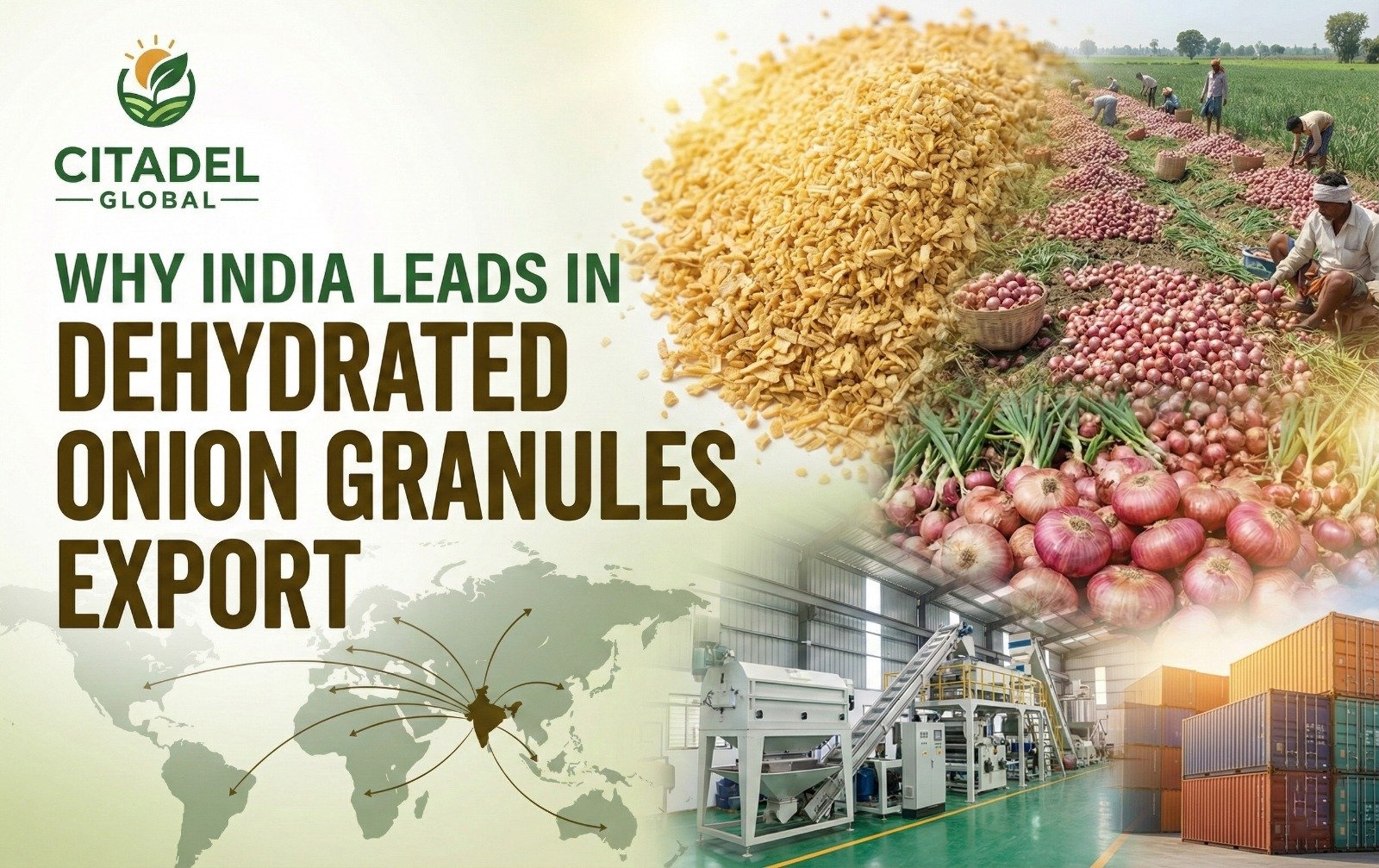
But when I zoomed into the export numbers for Dehydrated Onion Granules, the story shifted dramatically. India wasn’t just participating in the global trade — it was shaping it. In some years, it controlled nearly three-fourths of the global export share. That’s not a competitive position. That’s structural dominance.
And this matters more today than ever.
The global dehydrated onion market is currently valued between USD 1.2–1.5 billion (2024 estimate) and is expected to grow at a CAGR of 4.5%–6% through 2030. The surge is fueled by ready-to-eat meals, seasoning blends, snack flavoring, and shelf-stable industrial ingredients.
Among all formats, dried onion granules sit in a sweet spot:
Uniform particle size
Easy blending in industrial applications
Controlled texture
Long shelf life of 12–24 months
Moisture typically below 5%
This isn’t a surface-level trend. India’s leadership in Dehydrated Onion Granules exports is anchored in agriculture, infrastructure, policy, and industrial clustering. Let’s unpack why this dominance isn’t temporary — it’s structural.
The global dehydrated onion industry includes multiple formats:
Dehydrated Onion Granules
Onion flakes
Onion powder
Minced onion
Chopped onion
But from years of observing the onion processing industry, granules consistently emerge as the industrial favorite.
Why? Because granules offer control.
They’re finer than flakes but coarser than powder. That balance makes them ideal for:
Industrial seasoning ingredients
Instant noodle flavor sachets
Snack coatings
Sauces and soups
Institutional and military food supplies
The debate of onion powder vs granules usually comes down to texture and caking. Powder blends easily but can clump in humid conditions. Granules maintain flowability, reduce caking risk, and allow better dosing in automated systems.
As global food manufacturers scale production, ingredient consistency becomes non-negotiable. That’s where Dehydrated Vegetable Exports centered around granules gain momentum.
India is the second-largest onion producer globally, just behind China. Annual production fluctuates between 26–30 million metric tonnes (MMT), contributing nearly 20–22% of global onion output.
Key producing states include:
Maharashtra (~40% of output)
Gujarat
Madhya Pradesh
Karnataka
Rajasthan
But here’s the real differentiator: India cultivates dehydration-grade white onion varieties specifically for processing.
These varieties are:
Low moisture
High pungency
High solid content
Ideal for dehydration
Many countries rely on fresh-market onions and adapt them for dehydration. That compromises yield and consistency. India grows onions with dehydration in mind.
Multi-season cultivation, especially Rabi dominance, ensures year-round raw material flow. In supply chain terms, that reduces procurement volatility and strengthens export commitments.
This isn’t accidental dominance. It’s agricultural design aligned with industrial demand.
India accounts for 70–80% of global dehydrated onion exports.
Annual export volumes range between 100,000–150,000 MT, generating USD 200–300 million annually, depending on crop cycles.
A significant portion of this volume consists of Dehydrated Onion Granules, given their strong industrial demand.
Approximately 80% of India’s dehydrated onion production originates from Gujarat, especially clusters around:
Mahuva
Bhavnagar
More than 100 processing units operate within a tight geographic radius.
When industries cluster this tightly, efficiencies multiply:
Lower logistics cost
Shared labor pools
Technology diffusion
Competitive pricing pressure
Faster innovation cycles
This ecosystem explains why India’s leadership persists year after year.
India’s production cost is often 20–40% lower than Western producers.
Structural advantages include:
Lower labor costs
Lower land costs
Abundant raw material supply
Established drying infrastructure
Cluster-based logistics
Vertical farm-to-export integration
For global buyers, the equation is simple: lower per-metric-ton cost without compromising certification standards.
And unlike some competitors, India combines cost with scale. That’s a rare mix.
Modern Indian facilities deploy:
Hot air dehydration systems
Continuous belt dryers
Automated sorting & grading
Steam sterilization units
Metal detection systems
In-house microbial labs
Export-grade manufacturers maintain certifications such as:
ISO
HACCP
BRC
FSSC 22000
US FDA registration
Kosher & Halal
This enables access to stringent markets including:
United States
European Union
Japan
Middle East
Southeast Asia
India didn’t win on price alone. It matched — and often exceeded — compliance expectations.
Primary buyers include:
Snack manufacturers
Spice and seasoning companies
Instant noodle brands
Sauce & soup processors
Institutional catering suppliers
Fresh onion shelf life averages 2–3 months. Dehydrated Onion Granules last 12–24 months.
That difference transforms inventory planning.
Post-COVID, global packaged food consumption accelerated. Manufacturers prioritized shelf-stable ingredients to reduce risk and waste.
Granules also reduce transportation cost per flavor unit. Less water. More intensity. More efficiency.
India benefits from:
APEDA export promotion
RoDTEP incentives
Agri-export policy focus on processed foods
Logistics are strengthened by proximity to ports such as:
Mundra
Kandla
Nhava Sheva
Additionally, rupee depreciation enhances export competitiveness in USD-based trade.
These macro factors reinforce India’s structural advantage.
China: Scale strength but rising labor costs and quality scrutiny.
USA: High quality, high cost.
Egypt: Emerging but limited scale.
Spain: EU proximity but higher production cost.
India wins on:
Volume capacity
Price competitiveness
Flexible MOQs
Custom mesh sizes
Established buyer relationships
Consistency beats flash in global trade. India delivers both scale and reliability.
The process is streamlined:
Contract farming
Farm-level sorting
Washing & peeling
Slicing
Hot air drying
Grinding (mesh control)
Sieving
Metal detection
Bulk packaging (25 kg poly-lined kraft bags)
Conversion ratio:
6–7 kg fresh onion = 1 kg dehydrated product
Such integration reduces unpredictability across the value chain.
Challenges exist:
Seasonal price fluctuations
Drought
Unseasonal rainfall
Energy cost volatility
Mitigation strategies include:
Multi-state sourcing
Cold storage
Forward contracts
Diversified export markets
Dehydrated exports are typically less restricted than fresh onion exports, offering more stability.
The industry is evolving beyond volume:
Steam-sterilized granules
Low microbial variants
Organic dehydrated onions
Customized mesh sizes
AI-enabled sorting
Solar-assisted dehydration
Water recycling systems
The next growth phase is value-added differentiation.
Global buyers increasingly demand:
Clean label ingredients
Non-sulfited granules
Traceability systems
Reduced sulfur usage
Responsible water management
India’s clusters are adapting with solar drying and sustainability upgrades.
Top importers of Dehydrated Onion Granules include:
United States
Germany
UK
UAE
Japan
Netherlands
Russia
Brazil
The US and EU together account for a significant share due to robust processed food industries.
Ready-to-eat food CAGR: 5–7%
Clean label demand accelerating
Private label seasoning growth
Expansion into Latin America & Africa
Industry consolidation
Automation to sustain cost leadership
India is expected to maintain 70% global export share through the next decade.
India’s dominance in Dehydrated Onion Granules exports rests on:
26–30 MMT raw onion production
70–80% global export share
20–40% cost advantage
Cluster-based ecosystem in Gujarat
Strong certification compliance
Mature port infrastructure
Currency advantage
Alignment with global processed food demand
This leadership is systemic — built across agriculture, processing, policy, and global integration.
Why does India dominate Dehydrated Onion Granules exports?
Because of raw material scale, 70–80% export share, cost advantage, and strong Gujarat-based clusters.
What is the global market size of dehydrated onions?
Approximately USD 1.2–1.5 billion in 2024, with 4.5–6% CAGR projected until 2030.
Why are granules preferred over onion powder?
Better texture control, blending consistency, and lower caking in industrial applications.
Which countries import Indian dehydrated onion granules?
US, Germany, UK, UAE, Japan, Netherlands, Russia, and Brazil.
What is the shelf life of dehydrated onion granules?
Typically 12–24 months with moisture below 5%.
How much fresh onion is required to make granules?
Approximately 6–7 kg fresh onion yields 1 kg dehydrated product.
Understanding India’s leadership in Dehydrated Onion Granules exports isn’t about statistics alone. It’s about recognizing structural depth — agricultural scale, industrial clustering, compliance maturity, and cost precision working together.
For buyers and processors, supplier evaluation goes beyond price per metric ton. Certification standards, processing controls, traceability, and long-term reliability define sustainable procurement.
This is where experienced exporters matter — those who combine clean-label integrity, export-grade processing, and transparent trade practices.
Companies like Citadel Global represent this new generation of Indian agro exporters — rooted in certification, driven by traceability, and aligned with global compliance expectations. In a market where consistency defines success, choosing partners with structural strength makes all the difference.
Because in global ingredient trade, confidence is the real commodity.