Export Opportunities in Dehydrated Garlic Pieces from India
- March 03, 2026

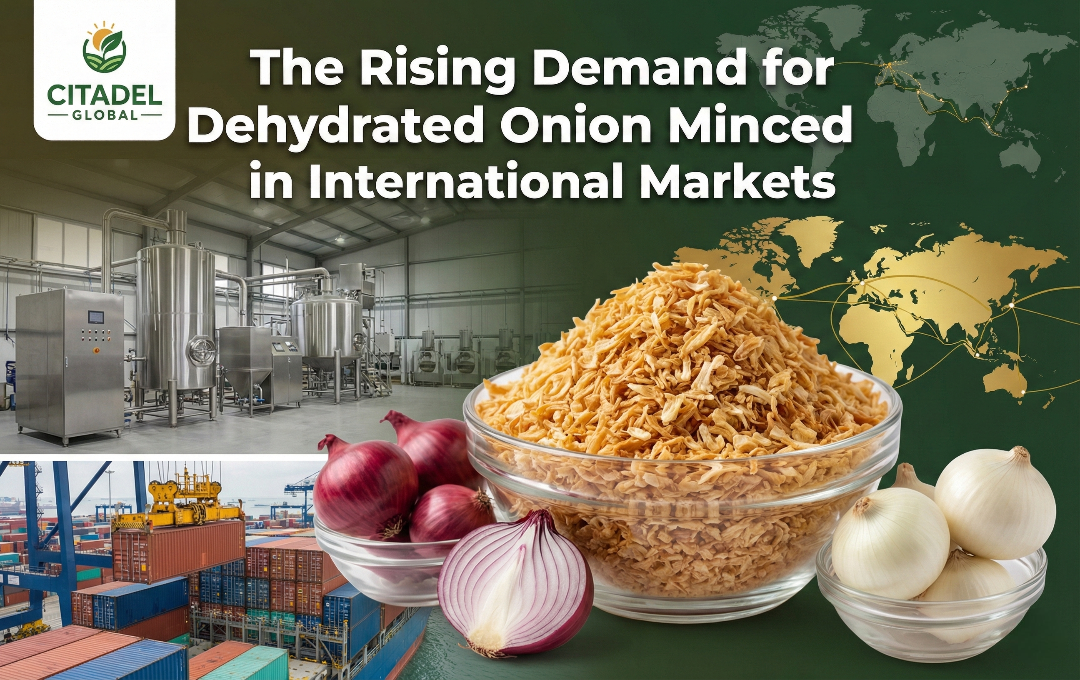
A few years ago, most food manufacturers treated dehydrated ingredients as backup inventory. A safety net. Something you leaned on when fresh supply got unpredictable. Then the world changed.
Supply chain disruptions, freight volatility, labor shortages in food prep units, and fluctuating fresh produce prices forced procurement teams to rethink everything. Suddenly, shelf life wasn’t just about convenience — it became a strategic decision.
That’s where Dehydrated Onion Minced quietly stepped into the spotlight.
What was once considered a secondary format began replacing fresh onions in industrial kitchens, seasoning plants, meat processing units, and frozen food factories. It moved from “optional” to “operationally essential.”
And the numbers tell the story.
The global dehydrated vegetables market was valued at approximately USD 75–80 billion in 2023, with a projected CAGR of 6–8% between 2024 and 2030. Onion-based dehydrated products account for roughly 18–22% of total market share, placing the global dehydrated onion market at an estimated USD 5–7 billion.
This isn’t a temporary spike.
It’s a structural transformation driven by:
Expansion of the processed food industry
Growth of QSR chains worldwide
Increased demand for standardized industrial food ingredients
Trade efficiency in the global dehydrated onion market
At the center of this shift sits one format that balances performance and practicality better than most: Dehydrated Onion Minced.
The onion processing industry offers multiple formats:
Onion powder
Onion granules
Onion flakes
Chopped onion
Dehydrated Onion Minced
Each serves a purpose. Powder disperses instantly. Flakes provide visual texture. Granules sit somewhere in between.
But minced? It’s the industrial middle ground.
In large-scale food production, consistency is everything.
Procurement managers and R&D teams often describe minced onion as the “functional sweet spot” between powder and flakes. Here’s why:
Faster rehydration compared to flakes
Better texture retention than powder
Uniform particle size for automated blending lines
Balanced flavor release in gravies and sauces
Highly adaptable in onion seasoning blends
Functional across meat processing and snack coatings
One seasoning manufacturer shared that switching from flakes to minced improved batch consistency across 20-ton production cycles. The difference wasn’t dramatic — it was subtle. But in industrial food processing, subtle consistency translates to fewer rejections and lower waste.
For any dehydrated minced onion supplier, that reliability becomes the differentiator.
Let’s look at scale.
Dehydrated vegetables market (2023): USD 75–80 billion
Projected CAGR: 6–8%
Onion share: 18–22%
Estimated dehydrated onion market: USD 5–7 billion
Within this, the minced segment captures a significant share due to its versatility across applications.
Structural growth drivers include:
Rising labor costs in food prep
Automation in food processing ingredients
Expansion of global spice trade
Reduced reliance on volatile fresh produce supply chains
Post-COVID, manufacturers prioritized shelf-stable ingredients to stabilize procurement planning. Fresh onions fluctuate wildly in price and availability. Dehydrated Onion Minced, by contrast, offers extended shelf life and predictable performance.
That predictability is currency in modern manufacturing.
The US processed food market exceeds USD 1 trillion annually. It is also the largest importer of dehydrated onion products.
Key demand segments:
Frozen foods
Ready-to-eat meals
Meat processing
Snack manufacturing
The clean-label movement is strong here. Buyers increasingly seek non-GMO and organic variants. In this region, standardization and compliance matter more than marginal cost savings.
The EU food processing industry generates over €1 trillion annually.
Major import markets include:
Germany
UK
Netherlands
France
Drivers:
Convenience soups
Ready meals
Plant-based meat alternatives
European buyers emphasize:
Strict MRLs
Traceability systems
BRC, ISO, HACCP compliance
In Europe, documentation strength can outweigh pricing advantage.
With projected CAGR of 8–10%, Asia-Pacific leads in growth rate.
Urbanization fuels demand for:
Instant noodles
Packaged gravies
Savory snacks
India and China function both as producers and high-volume consumers. Domestic consumption is rising alongside exports.
Import-heavy markets with high hospitality demand.
Advantages of dehydrated formats:
No refrigeration required
Long shelf life in hot climates
Reduced spoilage risk
Military catering and bulk spice blenders drive consistent demand.
Emerging QSR growth in Brazil and Mexico is increasing reliance on standardized dried onion ingredients.
India — particularly Gujarat — dominates the dehydrated onion exporters segment.
Advantages:
Large onion cultivation base
Competitive raw material cost
Established dehydration infrastructure
Major export destinations include:
USA
Germany
UK
Russia
Middle East
Export restrictions during domestic inflation cycles occasionally impact global pricing, reinforcing how interconnected the global spice trade truly is.
Strong industrial-scale processing and competitive pricing give China a consistent export presence.
Strategic proximity to Europe offers logistical advantages. Its export footprint continues to expand.
Though domestic production exists, imports remain cost-efficient for certain industrial buyers.
The global spice trade is valued at over USD 20 billion.
Dehydration removes 85–90% of water content.
Conversion ratio:
7–9 kg fresh onions = 1 kg dehydrated
Logistical advantages:
No cold chain
Lower freight weight
Reduced spoilage risk
Simplified international procurement
For importers, this translates to stable inventory management and lower transport volatility.
Used in:
Soups
Sauces
Instant noodles
Frozen meals
The global savory snack market exceeds USD 250 billion.
Applications include:
Chips seasoning
Extruded snacks
Savory biscuits
Sausages
Burger patties
Ready-to-cook meats
Bulk efficiency and taste standardization reduce prep time significantly.
Projected to reach USD 70–100 billion by 2030, plant-based products rely heavily on stable flavor bases. Dehydrated Onion Minced provides flavor depth without moisture variability — critical in vegan meat substitutes.
Primary drying methods:
Hot air drying (dominant)
Freeze drying (premium segment)
Vacuum drying
Modern processing achieves:
Moisture levels below 5–6%
Controlled sulfur levels
Enhanced microbial safety
Automation ensures:
Particle size consistency
Color retention
Compliance with international food safety norms
Pricing is influenced by:
Fresh onion yield
Climate patterns
Export bans
Energy costs
Freight rates
Fresh onion prices are notoriously volatile. In contrast, Dehydrated Onion Minced offers more stable pricing due to extended shelf cycles and forward contracts.
For procurement teams, this reduces budgeting uncertainty.
Key certifications:
HACCP
ISO 22000 / FSSC 22000
BRC (UK)
FDA compliance (USA)
Testing requirements include:
Salmonella
E. coli
Pesticide residue
Demand is rising for:
Organic certification
Halal
Kosher
Advantages:
Reduced food waste
Lower transport emissions due to reduced weight
Challenges:
Energy-intensive drying processes
Emerging trend: Solar-powered dehydration plants supporting ESG-aligned procurement policies.
The market remains fragmented.
Competition revolves around:
Pricing
Flavor retention
Certification portfolio
Microbial safety record
Particle uniformity
Export-focused companies securing long-term contracts hold competitive advantage.
Climate impact on onion yield
Regulatory tightening in EU
Export restrictions
Competition from synthetic flavor enhancers
Despite these, structural demand remains strong.
Projected CAGR remains 6–8%.
Drivers:
Urbanization
Working population growth
Food industrialization
Global cuisine integration
Emerging trends:
Organic Dehydrated Onion Minced
Contract farming
Automation
ESG-driven investments
The shift toward standardized, shelf-stable industrial ingredients is unlikely to reverse.
Expand certification portfolio
Invest in residue monitoring
Develop organic product lines
Secure long-term supply contracts
Diversify sourcing (India, China, Egypt)
Hedge against volatility
Monitor geopolitical shifts
Focus on Asia-Pacific growth
Explore solar-powered dehydration facilities
Target consolidation opportunities
The rise of Dehydrated Onion Minced reflects more than ingredient substitution.
It represents:
Processed food expansion
Shelf-stable preference
Cost optimization in manufacturing
Maturity of the global dehydrated onion market
Evolution of the global spice trade
Positioned between powder and flakes, it offers texture, performance, and logistical efficiency — making it one of the most adaptable industrial food ingredients in circulation today.
For manufacturers reassessing sourcing strategies, long-term partnerships matter more than short-term pricing.
Companies like Citadel Global, an Indian exporter of dehydrated agro products, reflect the new standard buyers increasingly look for — traceable sourcing, export-ready compliance, clean-label assurance, and bulk expertise aligned with international food safety requirements.
As the market moves toward stability, transparency, and performance-driven procurement, strategic supplier selection will define competitive advantage.
The opportunity isn’t temporary. It’s structural.
What is Dehydrated Onion Minced used for in the food industry?
It is widely used in sauces, gravies, seasoning blends, meat processing, snacks, and ready-to-eat meals due to its balanced texture and flavor release.
How long does Dehydrated Onion Minced last?
Typically 12–24 months when stored in cool, dry conditions in proper packaging.
Why is Dehydrated Onion Minced preferred over fresh onions for export?
Lower weight, no refrigeration required, longer shelf life, and reduced spoilage risk make it ideal for international trade.
Which countries are the largest exporters of dehydrated onion minced?
India, China, and Egypt are among the leading global suppliers.
How does climate affect dehydrated onion prices?
Crop yield fluctuations directly impact raw material cost, influencing overall pricing.
Is organic dehydrated onion minced in demand globally?
Yes, particularly in North America and Europe, driven by clean-label and health-conscious consumer trends.