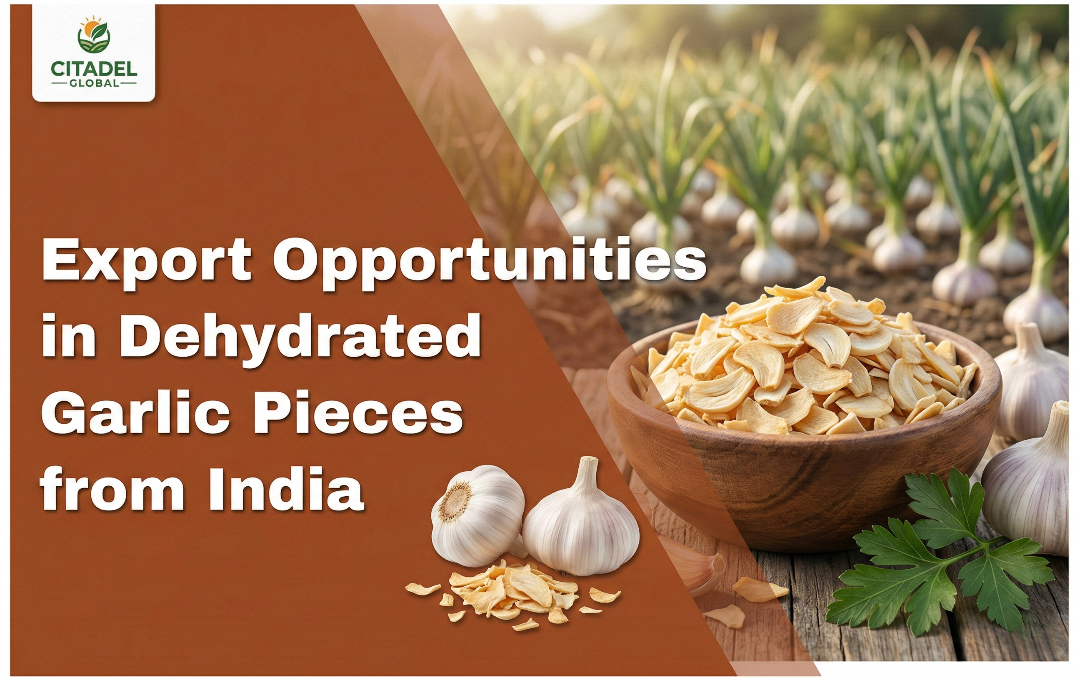
Export Opportunities in Dehydrated Garlic Pieces from India
- March 03, 2026

Walk through any international supermarket aisle and you’ll notice something interesting. That instant noodle cup in Jakarta? Garlic granules. The creamy pasta sauce in Berlin? Garlic flakes. A seasoning blend in Texas? Dehydrated garlic again.
Garlic has quietly gone industrial.
The global processed food industry isn’t just expanding — it’s scaling aggressively. And sitting right at the intersection of convenience, shelf stability, industrial seasoning, and clean-label food production are Dehydrated Garlic Pieces.
Food manufacturers today are chasing three things:
Longer shelf life
Flavor consistency
Compliance-friendly sourcing
Fresh garlic simply doesn’t tick all three boxes at scale. But dehydrated formats do.
The global dehydrated garlic market is growing at a double-digit CAGR across major consumption hubs, fueled by ready-to-eat meals, instant foods, spice blends, plant-based products, and commercial kitchens. Meanwhile, China’s long-standing dominance in the dehydrated garlic export space is facing increasing volatility — from supply disruptions to tightening compliance scrutiny.
India, on the other hand, now exports dehydrated agro products to over 160 countries. That isn’t accidental. It signals logistics maturity, global acceptance, and evolving compliance frameworks.
The opportunity isn’t theoretical anymore. It’s structural.
This article dives deep into where the real export potential lies for Dehydrated Garlic Pieces, what the numbers reveal, where the risks sit, and how Indian exporters can move from opportunistic trading to strategic positioning.
Industrial demand for dehydrated garlic flows from:
Seasoning blends
Ready-to-eat meals
Instant noodles
Sauces & dips
Meat processing
Plant-based alternatives
When food manufacturers scale, they can’t rely on inconsistent raw inputs. They need uniformity.
Fresh garlic varies in moisture, flavor intensity, and shelf life. Dehydrated Garlic Pieces, on the other hand, offer:
Shelf stability for months
Standardized flavor intensity
Controlled moisture levels
Lower spoilage risk
Easier international transport
Here’s the commercial truth: Buyers aren’t chasing the cheapest garlic. They’re chasing predictability.
Exporters who invest in moisture testing, microbial analysis, and particle-size standardization tend to secure long-term contracts. That’s where the shift in the processed garlic industry is happening — from commodity selling to compliance-led partnerships.
Indian dehydrated garlic exports to Europe tell a powerful story:
~2,280 tonnes in 2020
~4,640 tonnes in 2024
~19% CAGR growth
That’s not random fluctuation. That’s structural diversification.
Europe isn’t simply switching suppliers because of price. It’s responding to:
Supply disruptions
Rising compliance scrutiny
Tighter pesticide and aflatoxin norms
Demand for traceability
In short, Europe is buying safer, not cheaper.
United Kingdom – ~1,800 tonnes (largest importer of Indian dried garlic in the region)
Poland, Germany, Spain – fast growth from negligible volumes to significant tonnage
Emerging markets: Portugal, Romania, Bulgaria
The European seasoning industry is vast and compliance-heavy. ISO-certified garlic exporters with proper aflatoxin control and EU pesticide compliance are increasingly favored.
Strategic takeaway: If compliance frameworks continue strengthening, India could solidify its position as a top supplier in EU garlic flakes import demand — potentially second only to established leaders like Egypt and China.
Indonesia accounts for roughly 20% of global dehydrated garlic imports. Malaysia represents around 15%.
These are not fringe markets.
What’s driving this?
Instant noodles
Expanding middle-class consumption
Rapid growth in seasoning mix manufacturers across Asia
Strong domestic food processing industries
Here’s the commercial reality: Southeast Asia favors volume consistency. This is where bulk dehydrated garlic export matters.
Buyers here prioritize:
Competitive pricing
Reliable container schedules
Stable particle size
Garlic granules for noodles and seasoning blends
It’s less about boutique storytelling and more about performance at scale.
The U.S. dehydrated garlic market alone stands at approximately $540 million, growing at nearly 12.8% CAGR.
Demand drivers include:
Packaged food manufacturers
Food service chains
Spice blend processors
Private-label brands
This is a documentation-heavy market. FDA-compliant shipments, non-GMO certifications, and organic documentation matter as much as — sometimes more than — price per kilogram.
Organic Dehydrated Garlic Pieces command premium margins, especially within clean-label and health-focused product segments.
Buyers here scrutinize lab reports, supplier audits, and traceability frameworks before discussing volume expansion.
Brazil holds roughly 43% share in onion/garlic dehydrated imports in the region. Mexico accounts for around 14%.
Western dietary shifts and expanding food manufacturing are driving usage.
Opportunity lies in customization:
Particle size adjustments
Flavor intensity adaptation
Tailored moisture levels
Latin America represents a middle ground — higher volume potential than Europe, but slightly less compliance-heavy than North America.
The UAE plays a dual role: end-user market and redistribution hub.
Its HoReCa (Hotel, Restaurant, Catering) ecosystem is strong and expanding. More importantly, shipments into UAE often move onward into GCC markets like Saudi Arabia, Qatar, and Kuwait.
Halal-certified Dehydrated Garlic Pieces gain traction here.
In this region, logistics agility and trade relationships matter more than retail branding.
Countries like Ghana, Nigeria, and South Africa are steadily increasing processed food imports.
This is a patience market.
Processed garlic industry penetration is still developing, but early exporters who partner with regional distributors and provide moisture-controlled packaging can build long-term loyalty.
Margins may not spike immediately, but brand trust compounds over time.
Kazakhstan and Uzbekistan show rising processed food demand but limited Indian penetration.
Entry barriers exist — regulatory and logistical — but competition is lower.
Leveraging Russian trade bridges can ease access.
Harder entry. Less crowding. Potentially stronger margins.
Japan consumes roughly 50,000 MT of dehydrated garlic annually. South Korea consumes about 65,000 MT.
These markets demand:
Precise particle specs
Stringent testing
Exceptional reliability
Buyers pay more — but only for suppliers who meet exact standards.
These markets are smaller in volume but strong in premium positioning.
Demand centers around:
Natural processed ingredients
Organic dehydrated garlic
Clean-label positioning
Specialty suppliers who emphasize traceability and purity can capture niche segments here.
Higher margins. Strong demand in EU, North America, Japan.
Garlic combined with herbs for B2B seasoning companies creates differentiation beyond raw supply.
Garlic’s antioxidant profile supports nutraceutical and functional food positioning.
Partnering with global brands in private-label formats allows exporters to enter retail without building direct consumer brands.
Different compliance structures. Different margin profiles. Different branding strategies.
Smart exporters balance both.
Global convenience food demand expanding rapidly
Double-digit CAGR in global dehydrated garlic market
China’s volatility opening diversification windows
Buyers shifting toward traceable supply chains
Market diversification reducing export risk
The smartest exporters diversify across at least three regions — balancing premium, volume, and emerging markets.
HS Code Clarity – Correct classification (e.g., HS 0712 for dehydrated vegetables).
Certifications – EU Organic, GMP, ISO, FDA approvals.
Quality Testing – Low aflatoxin levels, pesticide compliance, traceability systems.
Packaging Innovation – Moisture-proof industrial packaging, resealable bulk packs.
Market-Specific Specs – Flakes vs granules vs powder depending on region.
Precision wins contracts. Not promises.
Regulatory tightening in EU
Freight volatility
Currency fluctuations
Overdependence on a single market
The antidote? A balanced regional portfolio and compliance-first positioning.
The export opportunity in Dehydrated Garlic Pieces is not scattered. It’s structured.
Europe offers fast growth and premium margins.
Southeast Asia delivers volume stability.
North America rewards compliance with high-value contracts.
Value-added formats unlock margin expansion.
But here’s the real shift happening globally: buyers are no longer looking for traders. They’re looking for partners who can deliver consistency, documentation, and purity — shipment after shipment.
In that environment, companies that combine advanced dehydration technology, FSSAI-certified processing, export-ready documentation, and a clean-label promise naturally stand apart.
This is where Indian exporters like Citadel Global quietly strengthen their position — focusing not on hype, but on traceable supply, moisture-controlled processing, and bulk export expertise tailored for global importers and food processors.
Because in today’s global trade landscape, what truly travels across borders isn’t just Dehydrated Garlic Pieces.
It’s confidence.
What makes Dehydrated Garlic Pieces suitable for export compared to fresh garlic?
They offer shelf stability, standardized flavor intensity, easier logistics, and reduced spoilage risk.
Which region offers the highest growth for Indian dehydrated garlic exporters?
Europe shows around 19% CAGR growth between 2020–2024, making it one of the fastest-growing regions.
What certifications are essential for exporting to the EU and US?
EU Organic, ISO, GMP, FDA approvals, and strict pesticide and aflatoxin compliance.
Is Southeast Asia more volume-driven or premium-driven?
Primarily volume-driven, with strong demand from seasoning and noodle manufacturers.
How can exporters differentiate beyond price?
By ensuring consistent particle size, moisture control, traceability, and private-label partnerships.
Are organic dehydrated garlic pieces more profitable?
Yes, especially in EU, North America, and Japan where premium pricing is accepted for certified supply.