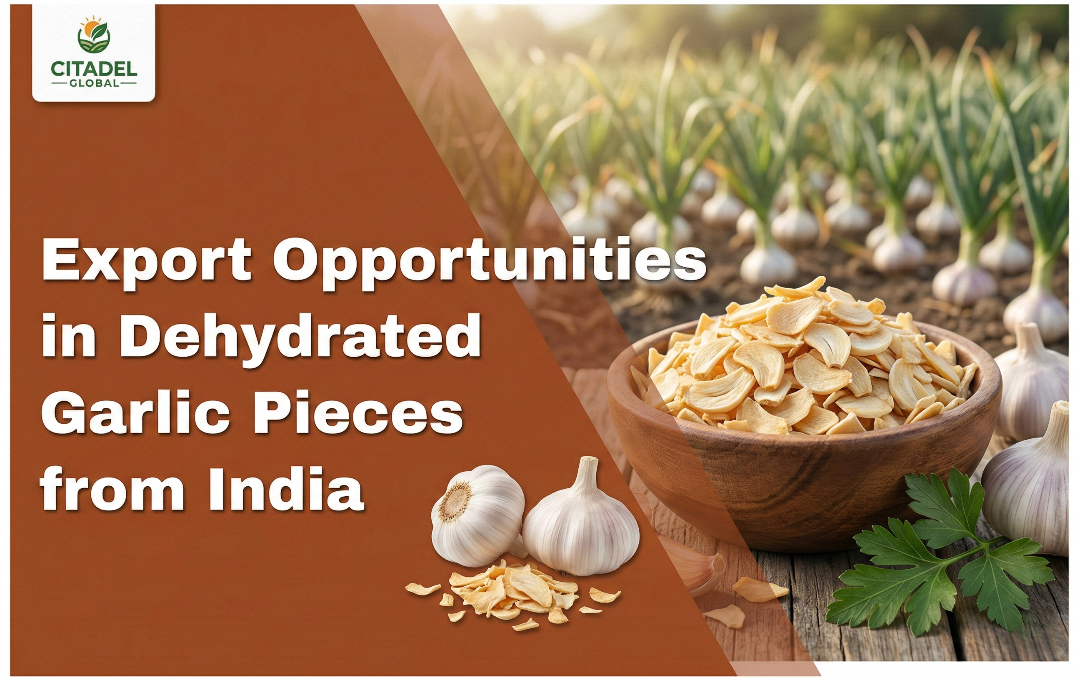
Export Opportunities in Dehydrated Garlic Pieces from India
- March 03, 2026


You're not the only one asking this. Every month, dozens of purchasing heads, food processors, and global importers quietly post the same RFQs. They want bulk organic dehydrated vegetable powders—nothing flashy, just pure, consistent, clean-label ingredients they can depend on.
But let’s be honest. Most of them still walk away... uncertain.
Not because the market lacks options—but because the options lack what truly matters: credibility.
You’ve probably been there.
A supplier who sounds great on paper. Quick replies. Low MOQ. Attractive pricing. Even a decent sample.
But then the first shipment arrives—moisture problems, missing certifications, and a COA that doesn’t match the batch. And just like that, what should have been a simple procurement becomes a brand liability.
So maybe the right question isn’t “Who’s the cheapest?”
It’s:
Who’s going to show up when the customs officer has questions about your food safety documentation?
Who’s going to help you scale your clean-label exports instead of making you clean up after theirs?
Let’s talk straight: The food industry has moved on.
“Organic” isn’t a luxury label anymore—it’s a baseline expectation. Especially in categories like:
Ready-to-eat meals
Functional beverages
Baby food
Nutraceuticals
Clean-label snacks
What do these industries want? Stable, shelf-ready, preservative-free ingredients that keep flavor and nutritional value intact—no matter where they ship from.
And the demand? Exploding. According to recent industry reports, the global market for organic food ingredient suppliers globally is on track to cross $95 billion by 2027. Much of that growth is being driven by buyers who demand supply chain transparency, not just pretty product catalogs.
In other words, you can’t afford to get your powders from just anyone anymore.
Let’s rewind to early 2024. A mid-sized formulation brand in Germany was sourcing from multiple vendors in Southeast Asia. Prices were attractive, but every delivery meant last-minute testing, repacking, or worse—rejections due to microbial inconsistencies.
They finally walked away from a 30% cheaper contract. Bold move? Definitely. Risky? Maybe.
But they partnered with a supplier who prioritized export documentation, proper dehydration, and traceable organic certification. The result?
Zero container holds
Faster time to market
No COA mismatches for six consecutive shipments
Sometimes, walking away from the cheapest deal is the most profitable decision you can make.
You’re not just buying powder. You’re buying everything that comes with it—or fails to.
Here’s what real global partners bring to the table:
Organic Certification That Travels
It’s one thing to be certified in your home country. It’s another to meet USDA, EU Organic, India Organic, and Gulf standards simultaneously.
Documentation Without the Guesswork
From invoices and COAs to phytosanitary certificates and shipping labels—everything arrives when and where it should.
Shelf-Life You Can Actually Trust
With advanced dehydration technology, shelf life isn’t just claimed—it’s measured, tested, and validated.
Flexibility in Packaging & Volume
From 20 kg to 1000 kg, smart suppliers offer scalable packaging that aligns with your operations—not theirs.
And most importantly: communication that doesn’t disappear post-payment.
As of 2025, the global pulse toward health-forward living has become far more than a trend. Here’s what’s shaping the market right now:
Clean-label now drives over 65% of product development in EU, GCC, and Southeast Asia.
Major US and German retailers have begun rejecting shipments that don’t meet traceable organic standards.
Demand for international suppliers of dehydrated food powders has tripled in the nutraceutical and baby food segment.
MENA and Eastern Europe are emerging as unexpected but high-volume buyers in the dehydrated category.
In other words—if you’re not sourcing clean, you’re already falling behind.
Fact 1: The global dehydrated vegetable market is valued at USD 9.8 billion and growing at 5.2% CAGR, with organic powders leading the charge.
Fact 2: Over 71% of EU importers now flag “clean-label with traceability” as their top sourcing priority.
Fact 3: Proper dehydration retains up to 95% of original nutritional value, giving you shelf life without preservatives.
This isn't the story of viral marketing or overnight success. It’s about an Indian exporter that built momentum the old-fashioned way:
By processing every shipment in FSSAI-certified units
By mastering export documentation across continents
By rejecting synthetic enhancers in favor of pure, natural ingredients
By scaling wholesale organic vegetable powders for export with trust, not tactics
Their quiet success? Now they're shipping to 28 countries—with buyers coming back not because of price... but because of performance.
If your current supplier can’t answer these questions, it's time to ask why:
How is moisture controlled before sealing?
Are COAs batch-specific and validated post-dehydration?
Is packaging air-tight, multi-layered, and export-compliant?
Are MSDS, phytosanitary, and Certificate of Origin delivered upfront?
What happens if customs requests additional documentation mid-transit?
A real organic vegetable powder wholesale supplier doesn’t just answer these—they anticipate them.
Behind every high-performing ingredient export is a supplier who values more than transactions—they value reputation. Not just theirs, but yours.
They understand that a delay in paperwork is a delay in your product launch.
That inaccurate COAs can tank entire shipments.
And that you’re not sourcing from them because you like vegetables—you’re sourcing from them because your brand depends on what they deliver.
We know a company like that.
Citadel Global didn’t start with a mega-factory or viral ads.
It started with belief—that clean-label products deserve clean partnerships.
Today, this Indian agro-exporter is trusted worldwide for dehydrated onion, garlic, wheat flour, and bulk organic powders that consistently meet export-grade benchmarks.
So, if you’re done gambling with your supply chain, maybe it’s time to start building one—with someone who treats your container like a contract, not a commodity.
Let’s talk.