Export Opportunities in Dehydrated Garlic Pieces from India
- March 03, 2026

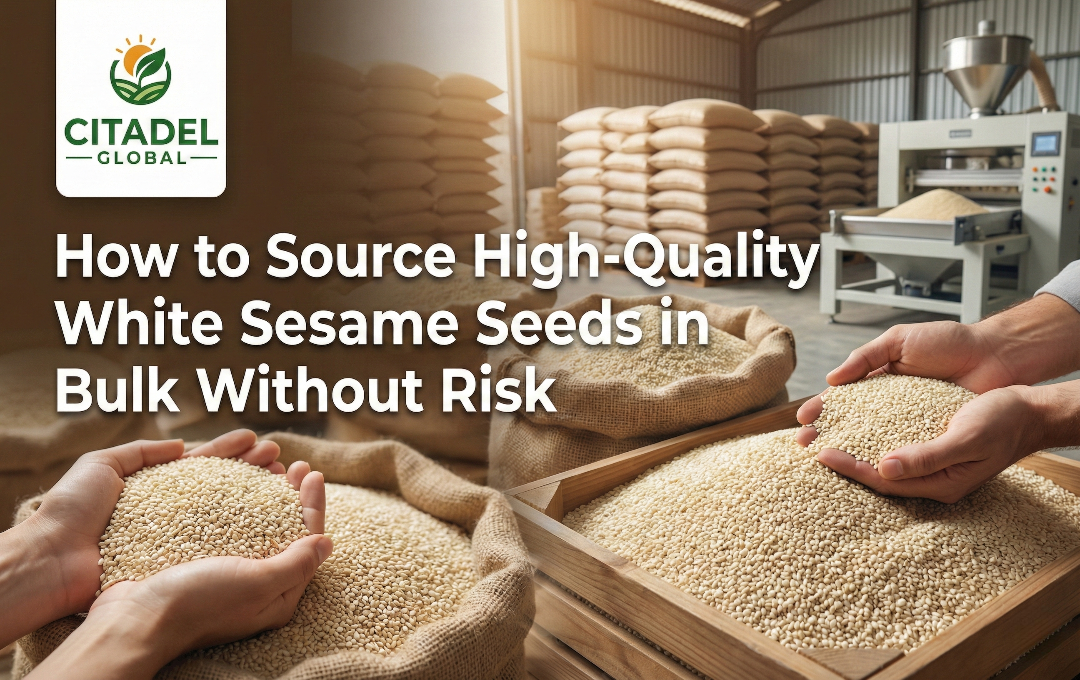
The global appetite for white sesame seeds has been quietly but steadily rising. From bakery toppings and confectionery coatings to cold-pressed oil, tahini, and health foods, these tiny seeds sit at the intersection of nutrition, flavor, and industrial utility. As consumption scales across food processing, retail brands, and export markets, bulk sourcing has become the norm rather than the exception.
India today stands among the world’s top producers of white sesame seeds, alongside Ethiopia, Sudan, and China. Yet while demand is global, quality is anything but uniform. Bulk sourcing promises cost efficiency and supply security—but it also exposes buyers to serious risks: inconsistent quality, contamination, aflatoxin failures, documentation gaps, and price volatility that can wipe out margins overnight.
This is why experienced buyers no longer approach sesame sourcing as a price-first decision. They treat it as a risk-managed supply chain exercise.
This article breaks down a structured, low-risk framework for sourcing white sesame seeds in bulk—grounded in market data, quality benchmarks, compliance realities, and real-world trade practices. Whether you’re a food processor, importer, or distributor, the goal is simple: protect quality, control risk, and build a sourcing model that scales without surprises.
The global supply of white sesame seeds is highly concentrated. A handful of countries dominate production, and origin plays a direct role in oil yield, seed size, cleanliness, and export acceptance.
India is known for its diverse sesame varieties and strong export infrastructure, particularly for food-grade and hulled seeds.
Ethiopia and Sudan are prized for high oil content and bold flavor profiles, often preferred for oil extraction.
China remains a major producer and consumer, with varying export volumes depending on domestic demand.
India’s sesame crop is primarily harvested during the kharif season (October–November). This harvest window significantly impacts availability and pricing. Buyers who understand this cycle can time contracts more effectively, while those who ignore it often pay premiums during lean months.
Bulk pricing for high-quality white sesame seeds typically ranges between USD 1,200 and USD 1,800 per metric ton, depending on grade, cleanliness, oil content, certifications, and origin.
Several variables influence these prices:
Weather patterns affecting yield
Government export policies and minimum support prices
Currency fluctuations in exporting countries
Freight costs and container availability
Short-term price dips can be tempting, but seasoned buyers know that unusually low pricing often signals compromises in quality or documentation.
The demand curve for white sesame seeds is driven by multiple sectors:
Bakery and confectionery industries value uniform color and low bitterness
Cold-pressed oil producers prioritize high oil content and purity
Export markets in the EU, Middle East, and East Asia demand strict compliance with aflatoxin and pesticide residue norms
As global buyers become more quality-conscious, sesame seed exporters capable of consistent compliance are gaining preference over spot-market traders.
High-quality white sesame seeds are defined less by appearance alone and more by measurable benchmarks:
Purity ≥98%, with minimal foreign matter
Moisture content ≤2%, critical for shelf life and mold prevention
Oil content averaging ~50%, especially relevant for processors
Even small deviations in moisture or purity can lead to spoilage during transit or rejection at destination ports.
For export-grade white sesame seeds, food safety is non-negotiable:
Aflatoxin limits ≤20 ppb (as per EU regulations)
Compliance with pesticide residue limits set by importing countries
Failure on these parameters doesn’t just mean rejected cargo—it can mean blacklisting with buyers and authorities.
While lab tests confirm safety, experienced buyers still rely on sensory checks:
Uniform white or creamy color
Consistent seed size
Clean, neutral aroma with no bitterness
True food-grade sesame seeds balance both lab compliance and sensory integrity.
Risk often begins with vague requirements. Before approaching suppliers, clarify:
Hulled vs. natural white sesame seeds
Intended use: food processing, oil extraction, or resale
Initial quantity: test lots versus full-container loads
Budget aligned with market benchmarks, including logistics and duties
A standardized RFQ prevents mismatched offers and costly misunderstandings later.
Bulk buyers typically explore multiple sourcing routes:
Domestic Indian mandis and APEDA-linked exporters
African origins for oil-focused requirements
B2B platforms—used cautiously, filtered by export history
Trade fairs, export councils, and industry networks often surface more reliable white sesame seed exporters than anonymous listings.
Never commit to bulk without validation:
Request representative samples
Conduct lab testing for moisture, purity, oil content, and aflatoxins
Verify certifications such as FSSAI, ISO 22000, HACCP, or Organic (where applicable)
Review export track records and buyer references
Red flags include pressure selling, incomplete documentation, or prices that defy market logic.
Contracts should protect both quality and capital:
Quality-linked pricing clauses
Secure payment structures (LCs, escrow, staged payments)
Clear Incoterms (FOB, CIF, etc.)
Inspection and rejection clauses
Insurance coverage for bulk shipments
Well-structured contracts turn uncertainty into managed exposure.
Execution is where theory meets reality:
Confirm purchase orders and documentation
Conduct pre-shipment inspections and fumigation
Track shipments with full traceability
Perform arrival inspections and post-delivery lab tests
Final payments should always follow quality verification—not precede it.
After delivery, evaluate:
Consistency of white sesame seeds quality
Communication and responsiveness
Adherence to timelines
Long-term buyers scale gradually, diversify suppliers, and use historical data to anticipate market shifts instead of reacting to them.
Prevented through certifications, audits, and regular lab testing.
Managed by aligning purchases with harvest cycles and balancing spot buying with longer-term contracts.
Mitigated via third-party inspections and verified export records.
Handled by understanding destination-country norms and insisting on complete phytosanitary and export documentation.
Buyers today aren’t just sourcing white sesame seeds—they’re sourcing accountability. Transparency, traceability, and clean-label compliance increasingly determine whether shipments clear ports or get rejected.
Ethical sourcing isn’t just about values; it’s about long-term cost efficiency. Traceable supply chains reduce disputes, recalls, and reputational risk—making them cheaper over time despite slightly higher upfront costs.
Sourcing white sesame seeds in bulk doesn’t have to be a gamble. When approached with a structured, data-backed framework, risks become predictable—and manageable.
The most successful buyers start small, validate thoroughly, and scale responsibly. They understand that quality failures in bulk sourcing are expensive, but also entirely avoidable with the right partners and processes.
This is where working with exporters who prioritize traceability, compliance, and long-term partnerships quietly changes outcomes. Companies like Citadel Global have built their approach around exactly these principles—focusing on documented sourcing, export-ready processing, and consistency over hype. Not as a sales pitch, but as a reflection of what the modern bulk buyer increasingly demands from the supply chain.
In a market where shortcuts are common, discipline becomes the real competitive advantage.
What is the ideal moisture level for high-quality white sesame seeds?
Moisture levels of ≤2% are considered safe for storage and long-distance transport, reducing mold and spoilage risks.
Which country produces the best quality white sesame seeds?
There’s no single “best” source. India, Ethiopia, and Sudan each excel depending on whether the priority is food-grade use, oil yield, or export compliance.
How can I verify if white sesame seeds are aflatoxin-free?
Only through accredited laboratory testing supported by official documentation.
Is it safer to source white sesame seeds domestically or internationally?
Domestic sourcing offers easier control for smaller volumes, while international sourcing can be cost-effective at scale—if compliance is managed properly.
What certifications should bulk buyers prioritize?
Mandatory certifications vary by market, but FSSAI, HACCP, and ISO 22000 are widely accepted baselines.
How much should I order for my first bulk purchase?
Test lots are strongly recommended. They reduce financial risk and provide real performance data before scaling.