Export Opportunities in Dehydrated Garlic Pieces from India
- March 03, 2026

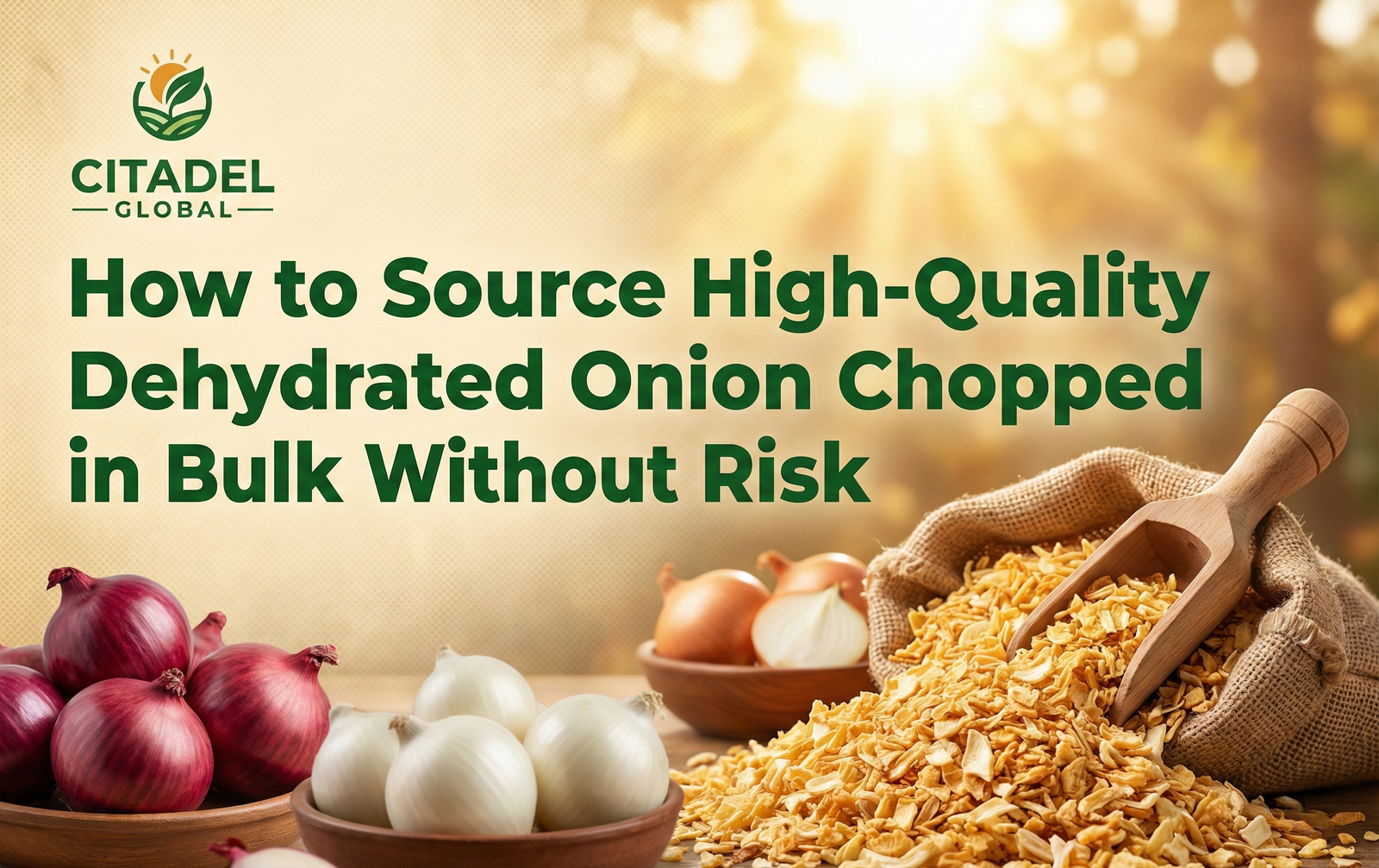
In global food supply chains, few ingredients look as simple—and cause as many downstream problems—as dehydrated onion chopped. On the surface, it’s just onion with the water removed. In reality, it’s a highly sensitive, quality-dependent ingredient that can make or break consistency, safety, and cost control across large-scale food operations.
From food manufacturers and HoReCa buyers to private-label spice brands and emergency food suppliers, dehydrated onion chopped is relied upon for flavor, shelf life, and operational efficiency. Buying it in bulk offers obvious cost advantages: lower per-unit pricing, fewer procurement cycles, and predictable inventory planning. But those advantages disappear quickly when sourcing decisions are driven by price alone.
Poor-quality bulk dehydrated onions can introduce hidden risks—microbial contamination, moisture instability, sulfite exposure, inconsistent flavor release, regulatory non-compliance, and even supplier fraud. These issues don’t always show up at arrival. They surface later, inside production lines, packaged goods, or worse, during audits and recalls.
This article breaks down how to source high-quality dehydrated onion chopped in bulk without risk—what to look for, what to verify, and why disciplined sourcing matters more than shortcuts. If you’re buying at scale, this isn’t optional knowledge. It’s operational insurance.
At its core, dehydrated onion chopped is produced by peeling fresh onions, chopping them into uniform pieces, and removing moisture through controlled dehydration. The goal isn’t simply drying—it’s reducing moisture below safe thresholds while preserving volatile flavor compounds, color integrity, and rehydration performance.
High-grade chopped onions typically reach moisture levels low enough to inhibit microbial growth while retaining structural integrity. When done correctly, dehydration extends shelf life dramatically—often 12 to 24 months—without preservatives, making the product ideal for global trade and long-term storage.
For buyers, the real value lies in consistency. A reliable chopped onion should behave the same way in every batch: same rehydration ratio, same flavor intensity, same yield.
The demand for dehydrated onion chopped spans multiple sectors:
Food processing: soups, sauces, gravies, seasoning blends, ready meals
Restaurants and institutional kitchens: predictable flavor, zero prep waste
Retail and private-label spice brands: long shelf life and uniform appearance
Emergency food and long-term storage: stability, safety, and ease of transport
In all these applications, inconsistency isn’t just inconvenient—it’s costly.
Global demand for dehydrated onion products continues to rise, fueled by convenience foods, clean-label expectations, and labor-saving ingredients. India, the US, and China remain dominant sourcing regions, each with distinct advantages and limitations.
At scale, experienced buyers learn quickly that consistent quality matters more than price. A cheaper supplier that causes production delays, rejections, or reformulations isn’t cheaper at all.
High-quality dehydrated onion chopped meets clear physical and sensory expectations:
Color: cream to light off-white; excessive browning signals overheating
Cut uniformity: consistent chopped size; excessive fines indicate poor processing
Aroma: clean, fresh onion notes—never burnt, musty, or sulfur-heavy
These indicators are early warnings. Ignoring them often leads to deeper quality failures.
Serious buyers don’t rely on appearance alone. They verify specifications that directly affect shelf life and safety:
Moisture content: low and stable moisture reduces microbial risk
Hot water insoluble solids: indicate purity and absence of fillers
Defect tolerance: controlled limits for skins, black specs, and foreign matter
Rehydration performance: proper swelling, flavor recovery, and texture
A supplier that can’t explain or document these metrics isn’t ready for bulk trade.
Food safety is non-negotiable when sourcing dehydrated onion chopped:
Acceptable limits for total plate count, yeast, mold
Zero tolerance for pathogens
Heavy metal compliance aligned with export markets
Preference for sulfite-free processing to meet clean-label demand
Clean-label markets increasingly reject shortcuts. Suppliers must adapt or be filtered out.
Export-grade dehydrated onion chopped should align with Codex, ISO, and UNECE standards, alongside market-specific compliance such as FSSAI, FDA, and EU food safety norms. Non-GMO, allergen transparency, and organic options are no longer niche—they’re competitive advantages.
Listings alone don’t equal legitimacy. Smart buyers go beyond surface-level B2B platforms by:
Cross-checking export records
Validating long-term shipment history
Verifying supplier presence in trade data and industry networks
Visibility over time is harder to fake than a polished profile.
Lower-risk dehydrated onion suppliers consistently show:
Vertical integration or strong farm-level partnerships
Batch-level documentation and traceability
Willingness to provide samples and third-party lab reports
Transparency isn’t a bonus—it’s a filter.
India offers strong advantages in onion varieties and dehydration expertise, the US excels in regulatory alignment, and China competes aggressively on price. However, seasonal variability, climate control, and processing discipline ultimately matter more than geography alone.
Not all certifications carry equal weight. For bulk dehydrated onion chopped, prioritize food safety systems that are audited regularly and recognized internationally. Third-party audits significantly reduce long-term risk and signal process maturity.
Before scaling volume:
Review the Certificate of Analysis (COA) carefully
Conduct independent lab testing when volumes or markets demand it
Compare multiple samples to assess batch consistency
Skipping this step is how small issues become expensive problems.
Traceability isn’t about paperwork—it’s about control. Lot coding, farm-level data, and recall readiness protect buyers when things go wrong. Suppliers who can’t demonstrate this aren’t built for serious export trade.
Pre-shipment inspections, random batch testing, and moisture management protocols reduce surprises. Sulfite exposure must be controlled and declared—especially for clean-label and export markets.
Diversifying sourcing and planning lead times protects against seasonal shortages and geopolitical disruptions. Buffer stock isn’t inefficiency—it’s resilience.
Start with manageable volumes. Use payment structures that protect first-time buyers. Contracts should clearly define quality specifications, rejection terms, and accountability.
Align product specs with end-market regulations before shipment—not after arrival. Documentation readiness prevents costly delays and rejected consignments.
Per-kilo pricing is only part of the equation. Yield consistency, rehydration performance, and rejection rates matter more over time. Real savings come from reliability.
Quality specs should be written, measurable, and enforceable. Clear replacement and penalty clauses protect both sides and encourage consistency.
Moisture- and oxygen-barrier packaging preserves shelf life. Bulk formats must balance protection with handling efficiency. Poor packaging can undo good processing.
Even the best dehydrated onion chopped can fail if exposed to moisture during transit. Packaging integrity, humidity control, and proper container practices are critical.
Cool, dry storage environments extend shelf life. Early signs of moisture ingress—clumping, odor changes—should trigger immediate action.
Correct rehydration ratios ensure optimal yield and flavor release. Consistent product performance simplifies production and reduces waste.
Bulk sourcing of dehydrated onion chopped rewards discipline. Buyers who prioritize verified quality standards, thorough supplier evaluation, and transparent documentation avoid costly corrections later.
This is where suppliers like Citadel Global stand apart—not by hype, but by alignment with how serious buyers actually think. With export-grade processing, FSSAI-certified facilities, clean-label practices, batch-level traceability, and a partnership-first approach, Citadel Global fits naturally into sourcing strategies built on consistency, compliance, and long-term reliability.
In bulk trade, trust isn’t claimed—it’s demonstrated shipment after shipment.
What moisture level is considered safe for dehydrated onion chopped?
Low, stable moisture levels that inhibit microbial growth are essential for shelf life and safety.
How can I tell if dehydrated onion chopped is low quality?
Discoloration, excessive fines, weak aroma, and poor rehydration are common red flags.
Is sulfite-free dehydrated onion chopped better for all applications?
For clean-label, export, and sensitive markets, sulfite-free options are increasingly preferred.
Which country is best for sourcing dehydrated onion chopped in bulk?
Quality depends more on processing discipline and compliance than geography alone.
How long does dehydrated onion chopped last in proper storage?
Typically 12–24 months under ideal conditions.
What certifications should I prioritize when sourcing for export markets?
Food safety certifications aligned with destination market regulations are critical.