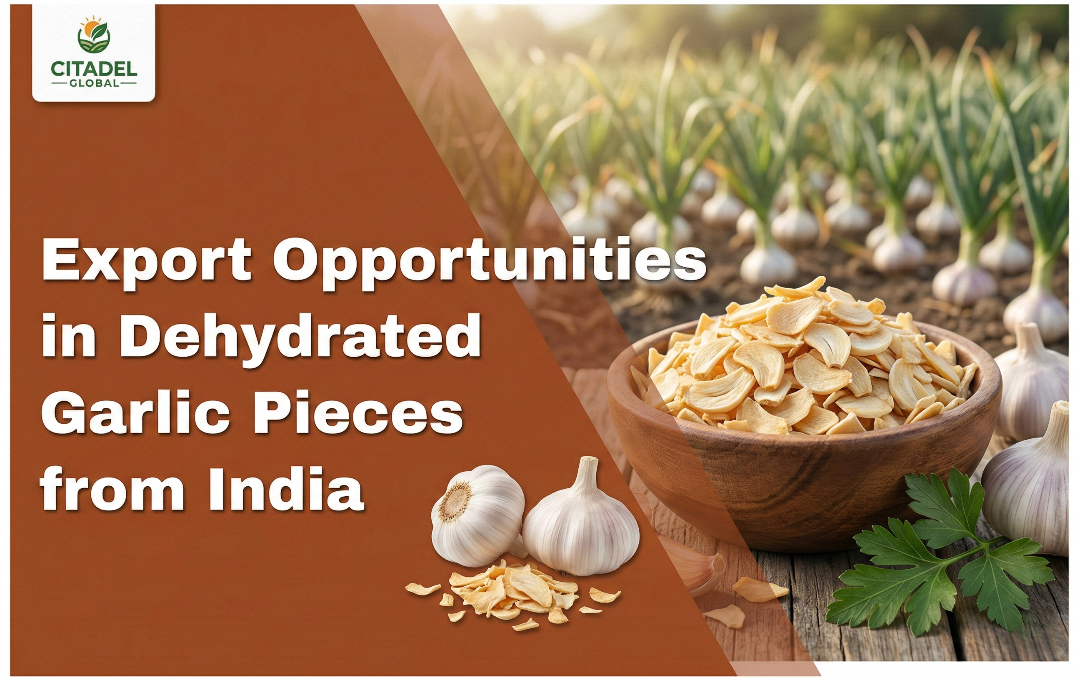
Export Opportunities in Dehydrated Garlic Pieces from India
- March 03, 2026


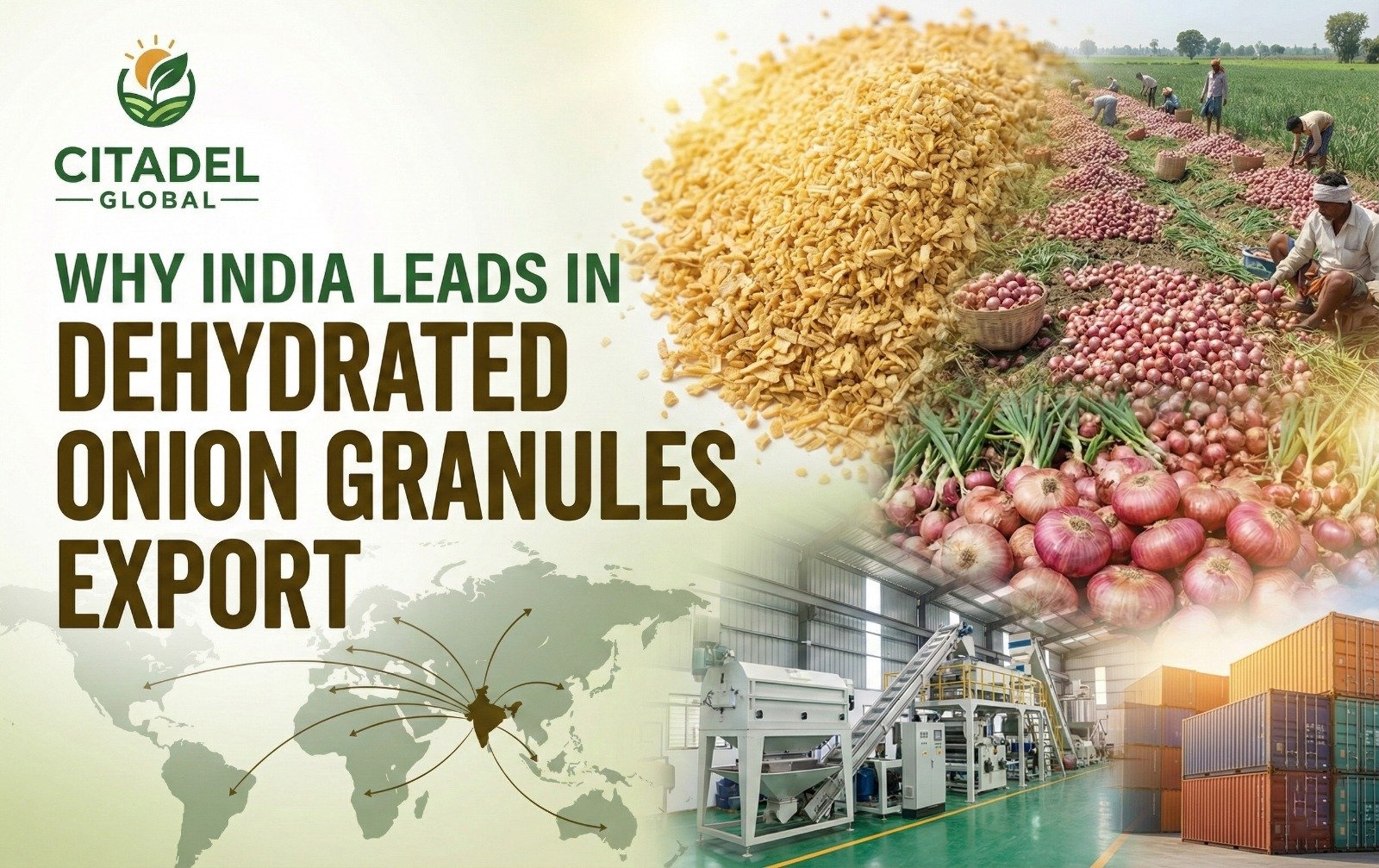
Dehydrated onion powder from India is not just a kitchen ingredient — it’s a globally traded commodity shaping industrial and retail food systems. From spice blends in European snacks to institutional kitchens in North America, Indian onion powder is everywhere. Its dominance comes from a precise combination of sourcing, processing, compliance, and logistics. This article presents a stepwise dissection of how Indian dehydrated onion powder leads the global market, including facts, trends, data, a case study, and an actionable conclusion.
Global demand for shelf-stable, consistent, and cost-effective ingredients is rising steadily. Dehydrated onion powder addresses all three, replacing bulky fresh onions while maintaining flavor, color, and aroma.
India accounts for roughly 70–75% of global onion powder exports, producing around 80,000 tonnes annually, with an estimated market growth rate (CAGR) of 4–5% over the next five years. Both white onion powder and dehydrated red onion powder serve diverse culinary needs: white powder for neutral seasoning and red for natural sweetness and color.
Scale and supply reliability: Large annual volumes support bulk exports, critical for industrial buyers.
Cost advantages: Efficient dehydration processes and low labor costs allow competitive pricing for dehydrated onion powder manufacturers in India.
Product versatility: Multiple powder grades and forms (flakes, granules, minced) meet a range of culinary applications.
Compliance & traceability: FSSAI-certified units, HACCP alignment, and batch-level traceability ensure export readiness.
Market fit: Buyers include spice blenders, wholesalers, food processors, and institutional kitchens, all demanding consistent quality
Clusters of dehydration units in Gujarat, Maharashtra, and Rajasthan dominate production. These regions benefit from proximity to raw materials and access to ports like Kandla and Mundra, enabling onion powder suppliers in India to deliver globally with efficiency. Plants are equipped to process 1,000–3,000 tonnes per season, ensuring India meets rising global demand.
Here’s a deep stepwise breakdown of how India achieves leadership, emphasizing processes, data, and systemic strengths:
India aggregates onions from multiple states, ensuring continuous supply. Contract farming and local aggregation hubs stabilize availability, allowing units to process up to 1,000 tonnes per month during peak season.
Dehydration units use controlled drying, moisture monitoring, and particle grading for powder, granules, and flakes. Uniform moisture content (typically 4–6%) and particle size ensures repeatable flavor and color.
Batch testing for pesticides, microbial load, and moisture is mandatory. Exporters maintain in-house labs for faster compliance. This step ensures Indian suppliers can meet stringent international standards, keeping rejection rates below 2–3%.
Low labor and energy costs, combined with bulk packaging options (25–50 kg bags, containerized shipments), allow exporters to remain price-competitive. This enables dehydrated onion powder wholesalers and bulk suppliers to operate at attractive margins.
India’s port connectivity and containerization allow shipments to Europe, North America, and the Middle East within standard transit times. Diversified export markets reduce dependence on a single region and spread risk.
Exporters provide test samples, flexible minimum order quantities (MOQs), and private-label solutions. Repeat buyers receive predictable quality, reinforcing India’s leadership position.
Investment in R&D enhances flavor retention, shelf-life (up to 12 months), and dehydration efficiency. Techniques like solar-assisted drying and optimized slicing thickness improve both product quality and environmental sustainability.
Impact: These seven steps collectively sustain India’s 4–5% CAGR in global dehydrated onion powder exports and maintain its 70–75% market share.
A Gujarat dehydration cluster sources fresh onions daily from regional farms. The onions are sorted, cleaned, sliced, and dehydrated with moisture control. Powder is graded, tested for pesticide residues and microbial load, and packed in bulk. Containers ship to Europe and the Middle East, where buyers receive uniform flavor across multiple shipments.
Result: Consistency, safety, and timely delivery reinforce India’s leadership in the global market.
Growing processed food demand: Dehydrated onion powder is critical for industrial kitchens and convenience foods.
Clean-label preference: Buyers increasingly demand powders free of preservatives or additives.
Industrial scaling: Larger dehydration plants with modern logistics enable India to meet the forecasted 4–5% CAGR growth in the next five years.
One kilogram of onion powder equals approximately nine kilograms of fresh onion, reducing storage and transport costs.
India exports around 80,000 tonnes annually, mainly as powder and flakes.
White onion powder is neutral, while red onion powder adds natural sweetness and color.
Private-label orders are common for importers seeking ready-to-sell products.
Dehydrated onion powders maintain flavor and aroma for up to 12 months under proper storage conditions
India’s dominance in dehydrated onion powder results from systematic sourcing, scaled dehydration, quality assurance, cost efficiency, logistics, market responsiveness, and continuous innovation. This stepwise system ensures consistent supply to global buyers, supporting India’s CAGR of 4–5% and maintaining a commanding market share.
Citadel Global exemplifies this pathway. With FSSAI-certified, clean-label processing and export-grade packaging, Citadel delivers bulk quantities efficiently while ensuring traceable quality. For importers seeking reliable onion powder suppliers in India, understanding these steps ensures partnerships with suppliers who can consistently deliver flavor, compliance, and scalability.