Export Opportunities in Dehydrated Garlic Pieces from India
- March 03, 2026

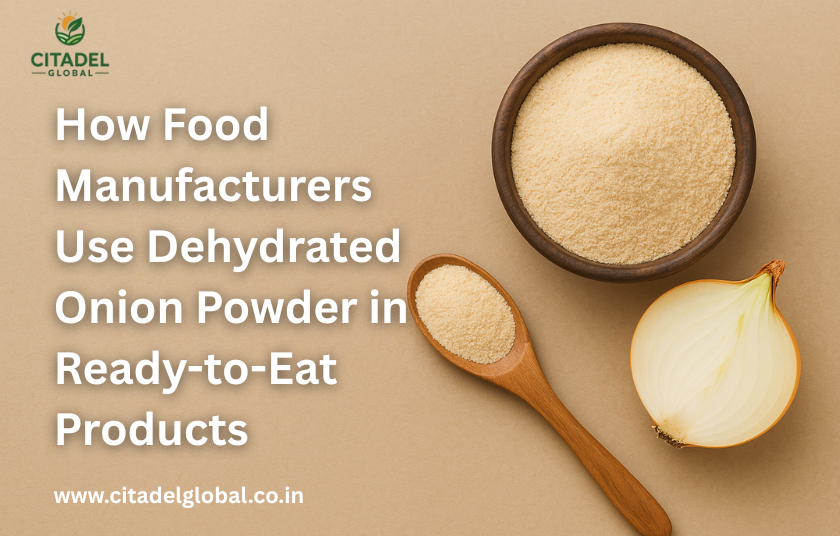
Dehydrated Onion Powder is one of those behind-the-scenes ingredients that quietly shapes the flavor of countless ready-to-eat (RTE) products. It’s concentrated, consistent, and effortless to work with — making it a staple in food factories that operate at scale. As global consumers lean heavily toward convenience foods, the demand for stable, reliable flavoring components has jumped sharply. And with RTE meals becoming a daily essential for millions, powdered ingredients like Dehydrated Onion Powder help manufacturers keep flavor consistent while ensuring long shelf life.
Today’s food brands don’t just need good flavor; they need repeatable flavor. That’s why this ingredient has moved from “optional” to “core component” in modern formulations.
Fresh onions are unpredictable — their sharpness, moisture content, and sweetness shift from batch to batch. For manufacturers producing thousands of kilograms at a time, this variability is costly. Dehydrated Onion Powder eliminates that uncertainty. Its flavor is standardized, stable, and reliable, which helps RTE brands maintain their signature taste every single time.
Moisture is the enemy of long-lasting food. Dehydrated Onion Powder contains very little of it, naturally lowering microbial activity and extending shelf life. This makes it ideal for packaged meals that need to maintain safety and flavor over months, not days.
No peeling, chopping, grinding, or waste management. The powder flows directly into mixing systems, reducing labor costs and simplifying production lines. Because it’s lightweight and concentrated, it also optimizes space and dramatically cuts storage and transportation inefficiencies.
Fresh onions spoil fast. They bruise, sweat, rot, and lose weight during transport. Onion powder, meanwhile, remains stable for months and replaces huge volumes of fresh produce. One ton of powder can replace nearly nine tons of raw onions — a major advantage for industrial-scale food processors.
This is where the ingredient really proves its versatility. It’s not just a flavoring agent — it’s a structural pillar in multiple food categories.
Instant curries, dehydrated sauces, gravy powders, and paste premixes rely on onion powder to build foundational flavor. It blends smoothly, disperses well, and eliminates the need for fresh onion processing.
From extruded snacks to chips, instant noodles, masala seasonings, and spice pouches, onion powder helps balance salty, tangy, spicy, and savory notes. It provides that unmistakable aromatic warmth that consumers associate with “real flavor.”
Whether it’s used in marinades, binders, or pre-mixes, the powder deepens umami and boosts aroma in frozen foods and heat-and-eat meals. It helps maintain texture without adding moisture — especially important for plant-based meats and frozen products.
Savory crackers, stuffed breads, and flavored doughs rely on onion powder for taste without interfering with hydration levels. Fresh onions would disrupt structure — the powder doesn’t.
Soups, ramen bowls, ready gravies, and dehydrated meal kits treat onion powder as a quick-release flavor booster.
It disperses evenly and prevents clumping, allowing manufacturers to build flavor layers in mayo-based dips, spreads, dressings, and emulsions.
With rising demand for “no artificial flavors,” dehydrated onion fits perfectly into natural-label recipes. It gives depth without additives.
Food scientists lean on its predictability to ensure that test batches match scaled batches — a key challenge in product development.
Manufacturers assess mesh size, volatile oil content, aroma strength, and sharpness — all indicators of quality.
Low moisture alone isn’t enough. High-quality suppliers follow strict hygiene protocols to ensure export-grade safety and compliance.
For sauces and liquid foods, the powder must dissolve evenly. For dry blends, it needs to disperse without clumping.
Each batch should match the last — essential for global brands that produce massive volumes daily.
Ready-to-eat product consumption continues to rise worldwide, driven by urbanization, busy schedules, and convenience-driven eating habits. With it comes a growing adoption of dehydrated spices and vegetable powders.
Industry reports project steady growth in the dehydrated vegetable sector, with onion powder holding a significant share thanks to its intense flavor and long shelf life.
Snack foods, instant mixes, frozen meals, and commercial seasoning blends are major contributors to the category’s expansion.
(During final quality control, real statistics can be layered based on available datasets.)
Even slight changes in color or aroma can disrupt entire product lines. Sensory consistency is non-negotiable.
Fine powders work best in sauces and liquids, while slightly coarse variants suit bakery and seasoning blends.
Global markets increasingly request clean-label ingredients, making these variants highly desirable.
Onion crops are seasonal and climate-dependent, which can directly affect availability.
Fresh onion market swings influence powder pricing — a key concern for large-scale procurement teams.
Since onions are natural ingredients, flavor and aroma can vary slightly by region and climate. Reliable suppliers help minimize this variation.
Choosing the right granulation ensures the powder behaves correctly in the final product.
Testing protects against inconsistencies before full-scale production.
Humidity is the enemy. Temperature-controlled, dry environments keep the powder potent and safe.
Quality certifications, traceability, hygiene standards, and advanced dehydration technology are essential indicators of a supplier’s reliability.
Convenience foods are rising globally. Clean-label formulations continue to gain momentum. And as manufacturers push for stable, flavorful ingredients that work across formats, the relevance of Dehydrated Onion Powder will only increase.
Its versatility, long shelf life, and ability to deliver consistent flavor make it a future-proof staple for RTE production.
Dehydrated Onion Powder has earned its place in modern food manufacturing by delivering reliability, depth of flavor, and scalability. It brings consistency to massive production lines, enhances taste across product categories, and supports the long shelf life that RTE meals depend on.
For brands that prioritize purity, traceability, and ingredient integrity, companies like Citadel Global strengthen the supply chain by offering export-grade, clean-label dehydrated onion products that meet global quality expectations. Their approach aligns with the industry’s shift toward transparent sourcing and dependable performance — values that shape the future of RTE food innovation.
If your team is exploring clean-label, export-ready Dehydrated Onion Powder for RTE formulations, consider evaluating suppliers like Citadel Global. Their traceable sourcing and consistent processing standards make them a strong fit for manufacturers who value reliability, purity, and long-term partnership.