Export Opportunities in Dehydrated Garlic Pieces from India
- March 03, 2026

A container arrives on time. The paperwork checks out. The pricing looked competitive.
But when the seals are broken, the reality hits—flakes are dull, aroma is weak, moisture feels off, and suddenly the “good deal” starts looking expensive.
For importers, dehydrated garlic flakes are one of those deceptively simple products that punish shortcuts. On paper, they’re shelf-stable and easy to trade. In practice, they’re a highly process-sensitive ingredient where minor quality deviations can ripple into flavor inconsistency, microbiological risk, regulatory trouble, and lost buyer trust.
This article isn’t about selling garlic. It’s about buying it right.
If you’re sourcing dehydrated garlic flakes in bulk—whether for food manufacturing, seasoning blends, or foodservice—this thought-leadership buyer’s guide breaks down what truly matters: quality benchmarks, safety parameters, global trade realities, and the non-negotiables that separate reliable supply from recurring risk.
At a glance, garlic flakes look like a commodity. After all, garlic is grown everywhere, and dehydration is a mature technology. But that assumption is exactly where many importers get burned.
Unlike whole spices, dehydrated garlic flakes are a processed ingredient. Their quality is shaped not just by the raw garlic, but by peeling methods, slicing precision, dehydration temperature, moisture control, hygiene protocols, and post-processing handling. A failure at any stage shows up later as muted flavor, reduced shelf life, or contamination risk.
Global demand for value-added spices is rising sharply. Food manufacturers and foodservice operators prefer dehydrated formats because they offer consistency, labor efficiency, and long shelf life. But as demand grows, so does supplier variation. The market today includes everything from export-grade, compliance-ready flakes to visually similar but technically inferior batches that barely meet minimum standards.
For importers, the real cost isn’t what’s paid per metric ton—it’s what happens after the product enters the supply chain.
Physical inspection is the first—and most overlooked—filter when sourcing dehydrated garlic flakes. While lab reports matter, visual and sensory cues often reveal problems before paperwork does.
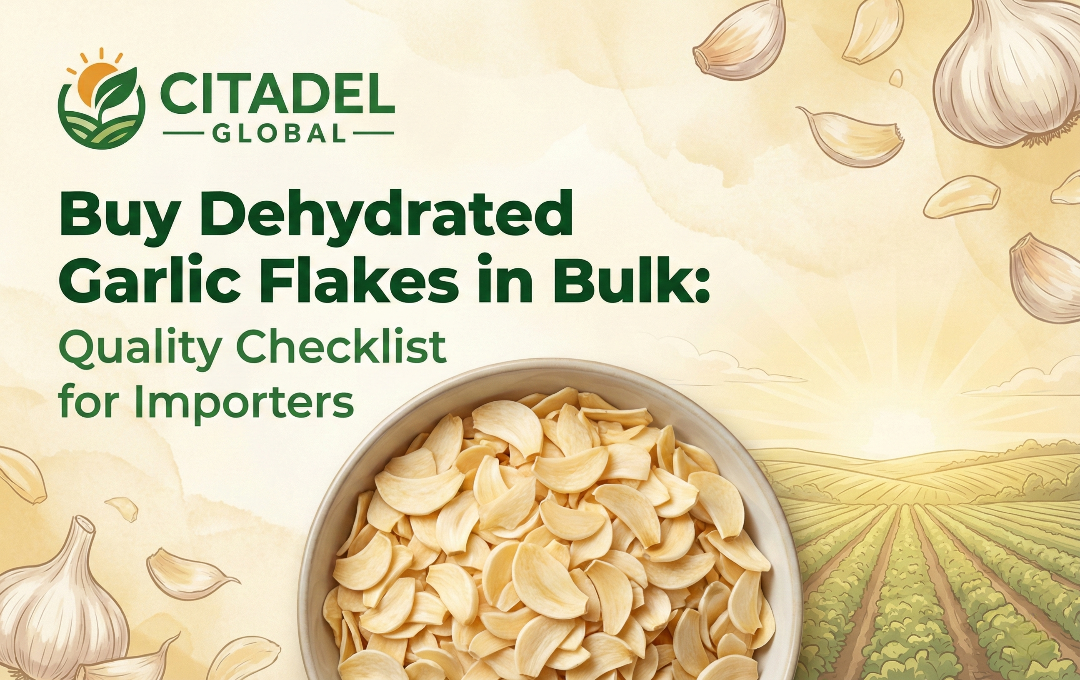
High-quality flakes should display a uniform white to light cream or off-white color. Dull, darkened, or blackened pieces are red flags, often pointing to improper dehydration, oxidation, or aging raw material. Color inconsistency across a batch usually signals process instability.
Garlic is unforgiving when it comes to aroma. Dehydrated garlic flakes should release a strong, pungent, unmistakably fresh garlic smell. Musty notes, sour hints, or flat aroma indicate volatile oil loss, microbial activity, or moisture exposure.
Flakes should feel crisp and dry, not leathery or pliable. Softness often correlates with elevated moisture content, which directly compromises shelf life and increases mold risk during transit or storage.
Most bulk buyers work with flake sizes ranging from 8 mm to 15 mm, depending on application. Uniform sizing isn’t cosmetic—it affects blending behavior, hydration rates, and visual consistency in finished products. Reliable suppliers can also offer custom sizing without excessive fines.
Export-grade dehydrated garlic flakes must be free from visible impurities such as dirt, stones, metal fragments, or insect matter. Even trace contamination can trigger rejections, recalls, or regulatory scrutiny in strict markets.
Chemical parameters are where long-term quality is either secured—or silently compromised.
Moisture is the single most critical factor in dehydrated garlic flakes. The generally accepted maximum range is 4.0% to 6.5%, with lower values preferred for extended shelf life. Excess moisture accelerates mold growth, clumping, and flavor degradation, especially in humid climates.
Total ash should not exceed 5.0%, while acid insoluble ash should ideally remain below 1.0% (with premium suppliers targeting ≤0.5%). Elevated ash values often point to inadequate cleaning or poor processing hygiene.
Flavor lives in volatile oils. A minimum of 0.3% volatile oil is widely regarded as a benchmark for acceptable flavor strength in dehydrated garlic flakes. Anything lower translates directly into weaker aroma and diminished performance in finished products.
Importers who ignore these numbers often discover the consequences only after customer complaints begin.
A batch can look perfect and still be unsafe.
Microbiological quality is non-negotiable when importing dehydrated garlic flakes, particularly for markets with stringent food safety regulations.
Total Plate Count (TPC): Typically ≤100,000 CFU/g
Yeast and Mold: ≤500 CFU/g
Pathogens: Salmonella and E. coli must be completely absent
An increasingly important metric is water activity (aw). Many food safety bodies recommend a maximum aw of 0.65, as microbial growth accelerates rapidly above this threshold—even if moisture percentages appear acceptable.
For importers, microbiological lapses aren’t just quality issues—they’re legal and reputational liabilities.
Compliance doesn’t end with microbes.
Dehydrated garlic flakes must fall within internationally accepted limits for heavy metals. For example, lead is typically capped at ≤2 mg/kg. Exceedances can result in outright shipment rejection.
Residue compliance depends on the importing market. The EU, in particular, enforces strict Maximum Residue Limits (MRLs). Importers must ensure suppliers test against the standards of the destination country—not just domestic norms.
While garlic itself isn’t a common allergen, cross-contamination risks exist. Importers often require supplier confirmation regarding the absence of allergens such as peanuts or gluten, depending on end-use requirements.
Technical specifications mean little if the supplier can’t deliver them consistently.
Reliable exporters of dehydrated garlic flakes typically hold certifications such as HACCP, ISO 22000, USFDA registration, and where relevant, Halal or Kosher approvals. Past performance, export history, and customer references matter just as much as certificates.
Never skip sampling. Physical inspection, aroma evaluation, and lab testing of samples often reveal gaps that documentation alone won’t catch.
Professional exporters should provide complete documentation, including:
Certificate of Analysis (COA)
Phytosanitary Certificate
Certificate of Origin (COO)
Incomplete or delayed paperwork is often a warning sign of deeper operational issues.
Bulk dehydrated garlic flakes should be packed in food-grade, double-layer moisture-proof systems, such as polyethylene liners inside corrugated boxes or multilayer sacks. Poor packaging negates even the best processing.
Container planning matters. As a reference:
20’ FT containers: ~13–14 metric tons
40’ FT containers: ~25–26 metric tons
Clear discussions on lead times, container stuffing, and transit conditions reduce surprises.
A mid-sized seasoning manufacturer once received two offers for dehydrated garlic flakes—one priced attractively lower than the other. On paper, both suppliers met basic specs.
During sample evaluation, however, the cheaper batch showed marginally higher moisture and borderline volatile oil content. The COA confirmed it. The importer rejected the offer.
Three months later, a competitor using the cheaper supplier faced mold complaints and a partial recall after transit through a humid region. The cost of rejection would have dwarfed the initial savings.
In bulk ingredient sourcing, specifications aren’t paperwork—they’re insurance.
The global trade of dehydrated garlic flakes is concentrated among a few key players.
Leading Exporters:
China, Spain, Argentina, the Netherlands, and Mexico dominate global exports, each with distinct processing strengths and market positioning.
Major Importers:
The United States, Vietnam, and Australia are among the largest importing countries, driven by food manufacturing, foodservice, and seasoning industries.
Market Trend:
Demand continues to rise for consistent, traceable, and clean-label dehydrated garlic flakes, particularly as manufacturers move away from fresh garlic to reduce labor and variability.
Lower moisture alone doesn’t guarantee quality if volatile oils are lost during aggressive dehydration.
Visually bright flakes can still fail microbiological tests if water activity isn’t controlled.
Uniform flake size improves not just aesthetics but flavor dispersion in blends.
Properly dehydrated garlic often delivers more consistent flavor than fresh garlic in industrial applications.
Sourcing dehydrated garlic flakes in bulk isn’t about finding the cheapest container—it’s about building a supply chain that holds up under scrutiny, scale, and time.
Importers who succeed treat quality parameters as strategic tools, not bureaucratic hurdles. They test, verify, document, and partner deliberately. In a market where visual similarity masks technical disparity, informed buyers always outperform opportunistic ones.
For importers seeking exporters aligned with these principles—clean-label processing, certified facilities, bulk expertise, and export-ready compliance—Citadel Global represents the kind of sourcing partner built around consistency rather than shortcuts.
Because in global ingredient trade, confidence isn’t claimed.
It’s delivered—batch after batch.